
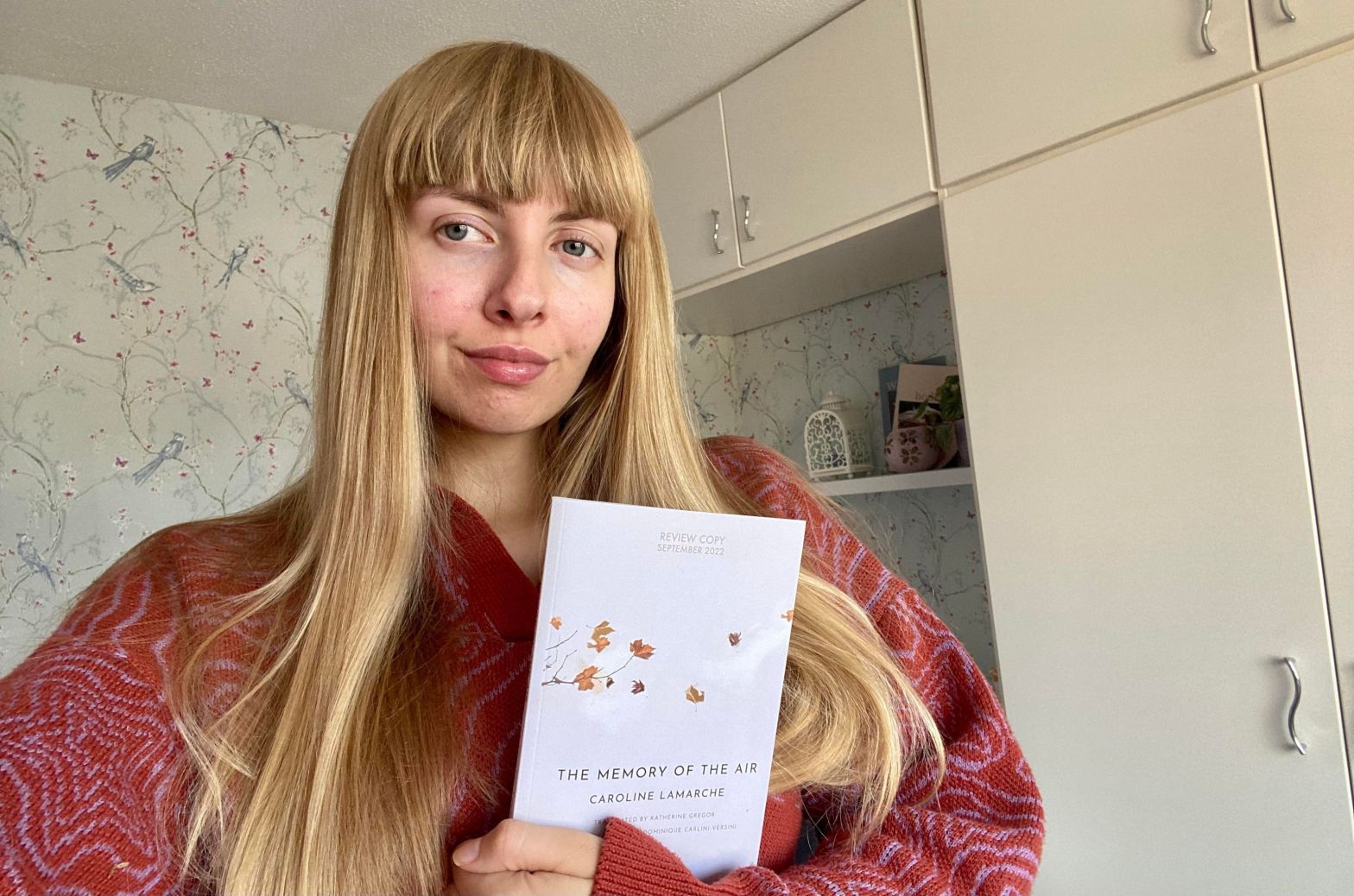
by Victoria Bromley
It’s incredible how much power a small book can hold as it pieces together the vulnerable narrative of a woman who’s trying to reclaim herself after experiencing abuse at the will of men.
TW: Sexual assault, abuse
Thank you Heloise Press for sending another review copy of one of your books. After we reviewed What Concerns Us, we were delighted to read more translated fiction which provides insight into cultural and emotional topics surrounding women and their bodies. At Swim Press we strive to promote women+ voices and empower the female body so this book yet again mirrors our values.
The Memory of the Air won the English PEN award and is written by Caroline Lamarche, translated from French by Katherine Gregor, and explores the damaging effect of sexual violence on women and their future relationships with men. Through lyrical prose, the narrator digs up her memory, scattering mud and soil in her wake, and takes the reader on a journey down into the roots of her assault. Written in short quick chapters which flick through her psyche, the narrator tells her story in snippets and vignettes to mimic the messiness of memory and the hesitance to be honest with herself.
The sadness of men is a disease I catch easily, I’m not made of marble, or rubber, or soap, or cloud, their discouragement doesn’t wash over me, it penetrates me, my skin is a sponge.”
The Memory of the Air

The book begins with the narrator seeing a dead woman at the bottom of a ravine and instantly forming an emotional and visceral connection with her. In a dreamlike, haunting trance, she finds a part of herself in the dead woman, broken and alone. While telling the story of her latest partner, an emotional abusive man, she refrains from using his name and instead calls him “Manfore” (the man before). It’s as if shielding his name was her taking away part of his identity, her way of healing to reclaim some power after his abuse stripped her of who she was and what she lived for.
I sometimes think I recognise the dead woman. Isn’t she who I was in Manfore’s arms as he watched silently, after our coming together, my transformation into a smiling dead woman, eyes shut, gone someplace else, far away?”
Memory of the Air
The trauma and pain she endured at the hands of men is woven between the pages and builds up her identity. Through emotional abuse, Manfore would defend his cruel actions by saying that she was being overly emotional and weak as she hadn’t processed the rape which she’d experience prior to their relationship. He used her pain as a weapon and made himself the victim. He would use her trauma and say that he no longer felt safe with her, gaslighting and manipulating her to shift and change her memory of events.
The following day, he said nothing had happened, that it had all been my fault, that I had started it, that it was I who’d raised my hand to him, that he’d been afraid.”
The Memory of the Air

On this journey to recovery, it was refreshing and bold to witness the narrator regain her confidence and self-worth. By trying to understand what had happened, that it wasn’t her fault, she was able to process the rape and come to terms with the fact it no longer had to define her. It was something she could now control and have ownership of.
As for the rest, this rape is mine. Every rape, like every instance of giving birth, is unique and belongs only to the woman who lived through it.”
The Memory of the Air
This book was incredibly moving, heart wrenching and overwhelming at times. But it is important for literature to explore these messy, emotional and traumatic themes so we can better understand those who have lived through these experiences and are still navigating their recovery.
The Memory of the Air is published by Helosie Press, 26th September 2022. Pre-order your copy here.
 swim press