
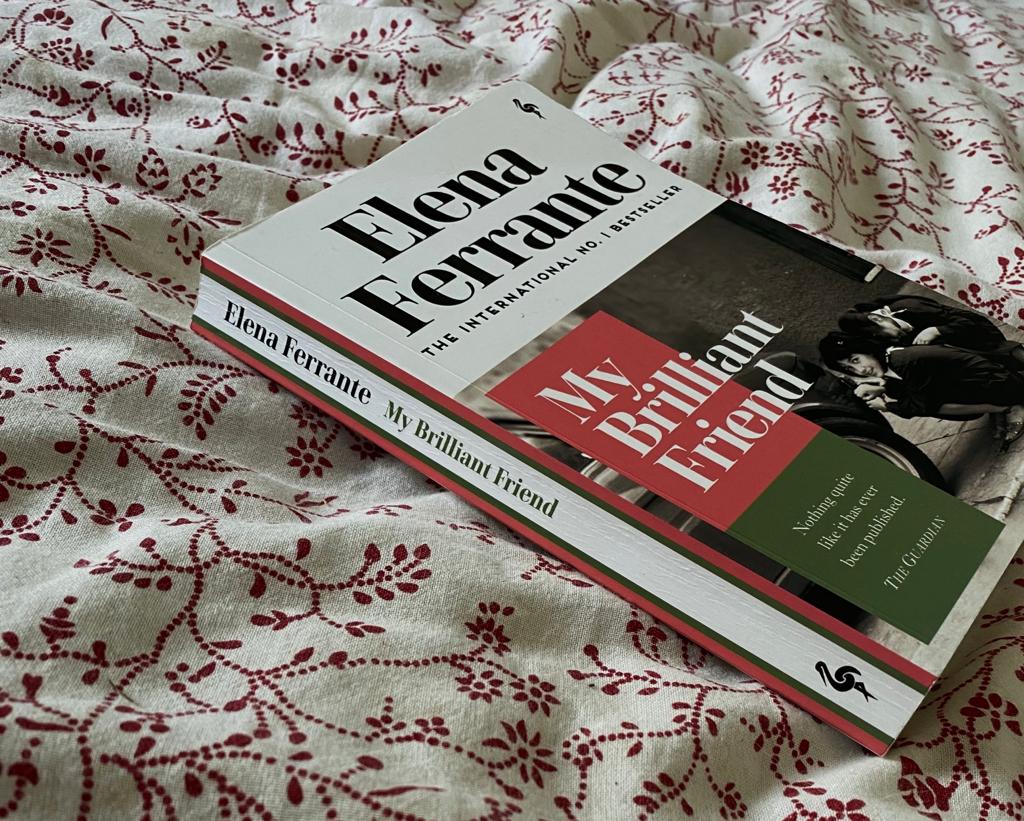
by Charlie Fabre
If you haven’t read any Elena Ferrante yet, here is your sign that you 100% should!
“I would have done anything for her, on that morning of reconciliation: run away from home, leave the neighborhood, sleep in farmhouses, feed on roots, descend into the sewers through the grates, never turn back, not even if it was cold, not even if it rained.”
I’ve had three Elena Ferrante novels on my bookshelf for a very long while now because I had just heard over and over again how amazing she is, how wonderful her stories are, and I knew she’d be worth reading, but it wasn’t until last week that I picked up My Brilliant Friend and I so wish I had started reading Ferrante’s work sooner! She lives up to every ounce of hype written about her, and more.
My Brilliant Friend is probably one of the best books I have read this year, and now that I’ve had a taste I just cannot wait to get my hands on the rest of the Neapolitan Quartet, and the rest of her work! To be completely honest and transparent, I did find it quite dense at first, I found it a little hard to get into because of how detailed the descriptions of the neighborhood and families are, but as the story progressed it was easier to immerse myself and I felt glad for all the descriptions done beforehand because the neighborhood felt palpable to me, like I was in it as well, and it truly became a character of it’s own that the story could not do without.
At first glance, My Brilliant Friend is sort of a coming of age novel about two young girls, Lenu and Lila, who have grown up in a poor neighborhood in Naples, Italy. At a second glance, it’s the story of these two girls discovering how large and vast the world is and how small they are in comparison, and how desperate they are to grow up and take up space and make something of themselves and find their place in this big big world. And then, at a third glance, the novel grows, just as the girls do, and it’s about their friendship which is incredibly close, sometimes a little unhealthy, and how Lenu and Lila almost have this desire and will to become one united entity: if one girl does something, the other girl must follow and do the same, they’re constantly playing catch-up to each other and silently competing.
“Then she returned to the theme of ‘before’. She said that we didn’t know anything, either as children or now, that we were therefore not in a position to understand anything, that everything in the neighborhood, every stone or piece of wood, everything, anything you could name, was already there before us, but we had grown up without realizing it.”
I love reading about messy twenty-something-year-old women, but above that I love reading about the messy lives of young girls, and young female friendship. There’s something so fierce about it, something animalistic in the way that young girls pack together, stick up for each other and help each other out, but are also equally jealous and cruel. It’s like female friendship is almost a mode of survival. There is so much love, and jealousy, and devotion in Lenu and Lila’s friendship, and I found it so interesting, specifically the devotion that Lenu feels towards Lila which almost transforms her into this mythical being within the realm of the neighborhood, which in a way she is: she is at first a scrawny and mean girl, smart beyond her years, though very poor and living with a rageful brother and father; but she stands her own and defies the hierarchy, and eventually the young girls want to be her friend and the boys want to claim Lila as their own. But later on, as Lenu continues school and Lila cannot, the roles switch, unbeknownst to Lenu, and we see the devotion and jealousy that Lila feels. Ferrante does such a brilliant (haha) job at showing the nuances of growing up as a young girl, but even more than that the nuances of growing up in this particular neighborhood – an underprivileged and violent place with a hierarchy of its own – and how this place specifically made both girls into who they are.
The neighborhood itself as a character is so important and multi-faceted, and the families, the strife, the violence, it’s all so tight-knit and intricate, you cannot pull one out of the loop without dragging all the others, and even though we hope and root for change, it doesn’t seem to come, and we’re not sure it ever will. For Lenu, she realizes this, and she realizes the potential she has, that she is bigger than this neighborhood and there isn’t enough room for her to continue to grow and live here. I hope that in the continuation of the quartet we see her leave it behind and find a place of her own; though it should be kept as a central figure and theme.
“I had the impression, from the way she used me, from the way she handled Stefano, that she was struggling to find, from inside the case in which she was enclosed, a way of being, all her one.”
And then there’s the plot about the shoes? The driving ambition and symbolism behind them? And there’s also a bit of a love story going on between our main girl Lenu and her school-mate Nino which I am hoping will continue on into the rest of the quartet… I do love a little friends to lovers affair. And the writing itself? How I couldn’t stop myself from devouring every piece of prose offered to me? There’s too much to cover, I could chat about this for days, but I fear the blog will get too long and you’ll lose interest, so all I’ll say now is that My Brilliant Friend and Elena Ferrante are a MUST READ and if I haven’t convinced you now I don’t know what will.
 swim press